
TABLE OF CONTENT
Introduction
On 18 May 2026, GitHub disclosed that approximately 3,800 internal source code repositories had been exfiltrated after a compromised VS Code extension executed on an employee workstation. The incident, tracked as The TeamPCP Supply-Chain Incident, is a stark reminder that modern supply-chain attacks no longer stop at application dependencies - they increasingly target the tools developers trust every day.
What makes this breach especially significant is not just the scale, but the architecture of the attack. This blog analyzes the implication of this breach, the operational impact and the defensive lessons that organizations must apply into their security design.
Why does this breach matter?
The most immediate consequence of the incident was the exposure of GitHub internal code and operational repositories, including material related to developer tooling, security research, enterprise server architecture, and support-related content. Even where no customer repositories were confirmed as accessed, the exposure of internal source and support excerpts creates meaningful risk, including intellectual property loss, operational insight for adversaries, and possible privacy or regulatory implications.
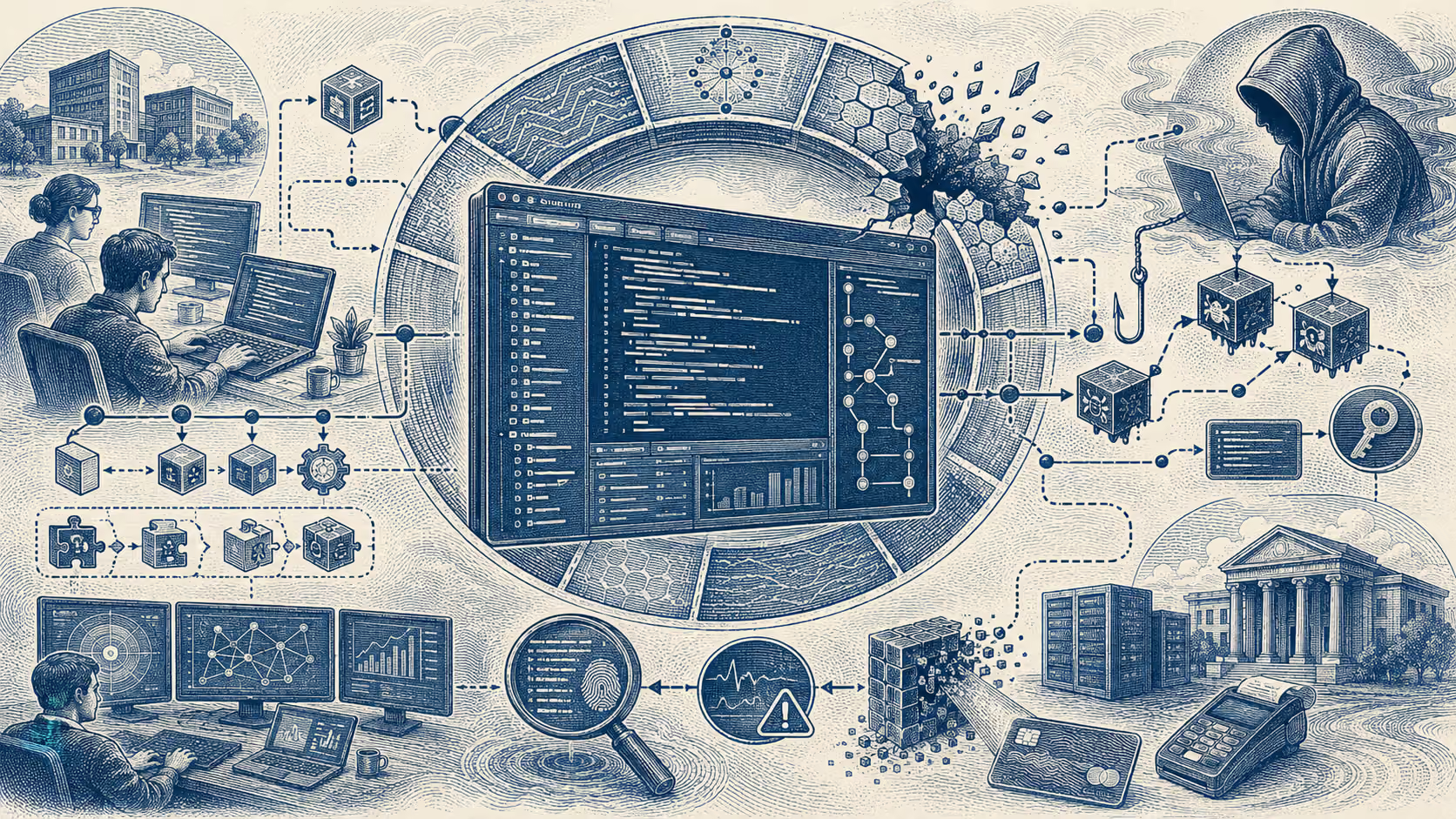
Equally important is the broader lesson for the industry. This incident demonstrates that the developer workstation has become a first-class attack surface. IDEs and extension marketplaces are no longer just productivity layers; they are privileged entry points into source code, cloud credentials, and production-adjacent systems. When an attacker can compromise a developer tool and pivot from there into internal repositories, the security boundary has effectively shifted closer to the developer than many organizations assume.
The campaign also exposes a serious limitation in provenance-based trust models. The wider TeamPCP activity showed that malicious packages can be published with apparently valid SLSA provenance when signing credentials are stolen. That means supply-chain signatures remain valuable, but they cannot be treated as a stand-alone defense. If the identity used to sign or publish software is compromised, the signature still verifies even though the software is malicious.
Operational impact and key takeaways
The operational impact of this breach extends beyond the repositories themselves with second-order consequences on multiple fronts.
Firstly, internal code exposure can accelerate reverse engineering, reveal security controls, and expose product architecture that helps attackers plan future intrusions. In a large engineering organization, internal repositories often contain deployment logic, service integrations, debugging utilities, and tooling that are not intended for public consumption but are highly valuable to an adversary.
Secondly, the incident also demonstrates how quickly a compromised extension can propagate. Auto-update mechanics, which are normally a security strength, became an attack amplifier because a malicious update was distributed and activated before defenders had time to fully assess it. That short dwell time is particularly concerning: a brief compromise window was enough to impact thousands of sessions and compromise at least one high-value workstation.
Thirdly, for security teams, the incident raises the bar on endpoint telemetry, identity monitoring, and repository auditing. Organizations must assume that compromise can begin in development tools, not just email or web browsing, and that stolen credentials may be present in local developer contexts that are usually outside traditional server-focused monitoring.
What this incident really means: Four key takeaways
More than a single compromise, the TeamPCP incident revealed how modern software ecosystems are built on layers of implicit trust, from IDE extensions and update channels to signing identities and developer credentials. These four takeaways show how trust is being weaponized inside software supply chains.
1. The IDE (Integrated Development Environment) Is Now a Primary Attack Surface
For years, the focus of supply-chain security was on production dependencies - the libraries on your application ships. This incident demonstrates that the development environment itself is now an equal-priority attack surface. A developer's IDE has access to source code, cloud credentials, API tokens, and - as this case shows - can serve as a pivot point into the organization’s entire internal network. Security controls need to reflect that reality.
2. Auto-Update Is a Critical Vulnerability
The fact that approximately 6,000 developer sessions activated a malicious extension during an 18-minute window is a direct consequence of automatic extension updates. Auto-update is a security feature when the update is benign - it keeps software patched. But it is an attack amplification mechanism when the update channel itself is compromised. The solution is not to disable auto-update but to add age-gating: require new extension versions to be available for 48 hours before they propagate automatically.
3. Provenance Attestation Is Not the Last Line of Defense
SLSA Build Level 3 was positioned as a near-definitive provenance guarantee for npm packages. The TanStack wave - which produced valid SLSA attestations for 84 malicious packages - proves it is not. Provenance answers "was this built correctly?" It does not answer "was the builder's identity compromised?" These are different questions, and the security community needs to be clearer about that distinction when advising organisations on what provenance attestation does and does not protect against.
4. The Blast Radius of Developer Credentials Is Dangerously Large
The GitHub employee whose machine was compromised had, through their development environment, access to AWS IAM roles via IMDS, Vault tokens, npm publish credentials, and a GitHub token capable of cloning 3,800 internal repositories. That is an enormous credential blast radius for a single workstation compromise. Least-privilage principles that are well-established for service accounts and production systems are rarely applied with the same rigour to developer workstations. This incident should change that.
Defensive Lessons
The TeamPCP Supply-Chain Incident offers several clear lessons for security leaders and engineering organizations.
- Treat developer workstations as sensitive assets with tightly controlled credentials, not as general-purpose endpoints.
- Add quarantine or age-gating controls for newly published extensions and packages so they do not propagate instantly across fleets.
- Rotate all credentials reachable from a potentially compromised workstation, including GitHub, cloud, Vault, npm, and secret management tokens.
- Monitor for suspicious extension behavior, hidden child processes, unusual CLI execution, and unexpected access to local secret stores.
- Use provenance, signing, and trusted publishing as layered controls, not as final proof of safety.
The core lesson is simple: if an attacker can reach your developers, they can often reach your code. And if they can reach your code, they may be able to reach your customers, your infrastructure, and your intellectual property.
Recommended Precautionary Actions
The following actions are precautionary and proportionate. None of them imply your environment is currently compromised, but they represent the baseline hygiene required to mitigate the blast radius of this campaign.
- Audit GitHub PATs & OAuth Apps (Immediate): Review all Personal Access Tokens in your organization. Revoke anything with a broad scope (repo, admin) that isn't actively needed. Check Settings → Developer settings → Personal access tokens.
- Rotate GitHub Secrets & Actions Tokens (Immediate): Rotate all GitHub Actions secrets, deploy keys, and environment secrets in your repositories. Pay special attention to secrets with written or admin permissions.
- Check VS Code Extension Exposure (Immediate): Identify developers who installed or updated Nx Console between May 15–20, 2026. Treat any credentials on those machines as potentially compromised and rotate them accordingly.
- Patch GitHub Enterprise Server (This Week): If running self-hosted GHES, upgrade to version 3.19.3 or later. This patches the separate but related RCE vulnerability CVE-2026-3854 (CVSS 8.7).
- Enable GitHub Audit Log Streaming (This Week): Stream your organization's audit logs to your SIEM or security tooling. This serves as your early-warning system if TeamPCP attempts to use stolen architectural knowledge for a follow-on attack.
- Review Third-Party OAuth App Access (This Week): Audit which third-party OAuth apps have access to your GitHub organization. Revoke any that is unused, untrusted, or possess excessive permission.
- Harden Developer Endpoint Controls (30 Days): Enforce an approved VS Code extension allowlist where possible. Treat the developer's workstation as a perimeter, not a trusted zone. MDE/EDR coverage on development machines is non-negotiable.
- Watch for TeamPCP IOCs (Ongoing): Monitor threat intelligence feeds for UNC6780 / TeamPCP indicators. Wiz Research, Google TIG, and SOCRadar are actively publishing updated IOC sets.
Conclusion
The TeamPCP Supply-Chain Incident is more than a single breach; it is a blueprint for the next generation of supply-chain compromise. By chaining trusted tools, legitimate update channels, and stolen identities, the attackers demonstrated how quickly confidence in developer ecosystems can be turned into organizational exposure.
For defenders, the message is urgent. Security controls must move upstream into the developer to experience itself, where identity, code, and tooling converge. The organizations that adapt quickly will reduce their exposure; those that continue to trust developer tooling by default may find themselves facing the same kind of breach under a different name.
How Can SISA Sappers Help?
If you would like support assessing your exposure or implementing the controls above, SISA Sappers – SISA’s DFIR unit offers:
- GitHub Organisation Security Review: An extensive audit of your Personal Access Tokens (PATs), third-party OAuth applications, GitHub Actions secrets, and overall platform access controls to reduce credential blast radius.
- Developer Endpoint Forensic Triage: A rapid forensic assessment of your developer workstations to determine if specific machines pull the malicious nrwl.angular-console build during the critical exposure window.
- Threat Intelligence Briefing: A tailored engineering and leadership briefing diving deep into TeamPCP (UNC6780) tradecraft, active Indicators of Compromise (IOCs), and environment-specific detection logic.
- DFIR Retainer Activation: If your organization already maintains an active Sappers Digital Forensics and Incident Response retainer, please contact your named primary analyst directly for immediate, priority escalation assistance.