
Blog
January 30, 2026
2
MIN READ
Payment Forensics in Banks: Common Breach Scenarios
Discover why modern bank payment breaches are evolving. Learn how payment forensics uncovers risks in RTPS, APIs, and privileged identities to protect real-time financial workflows from sophisticated hijacking.
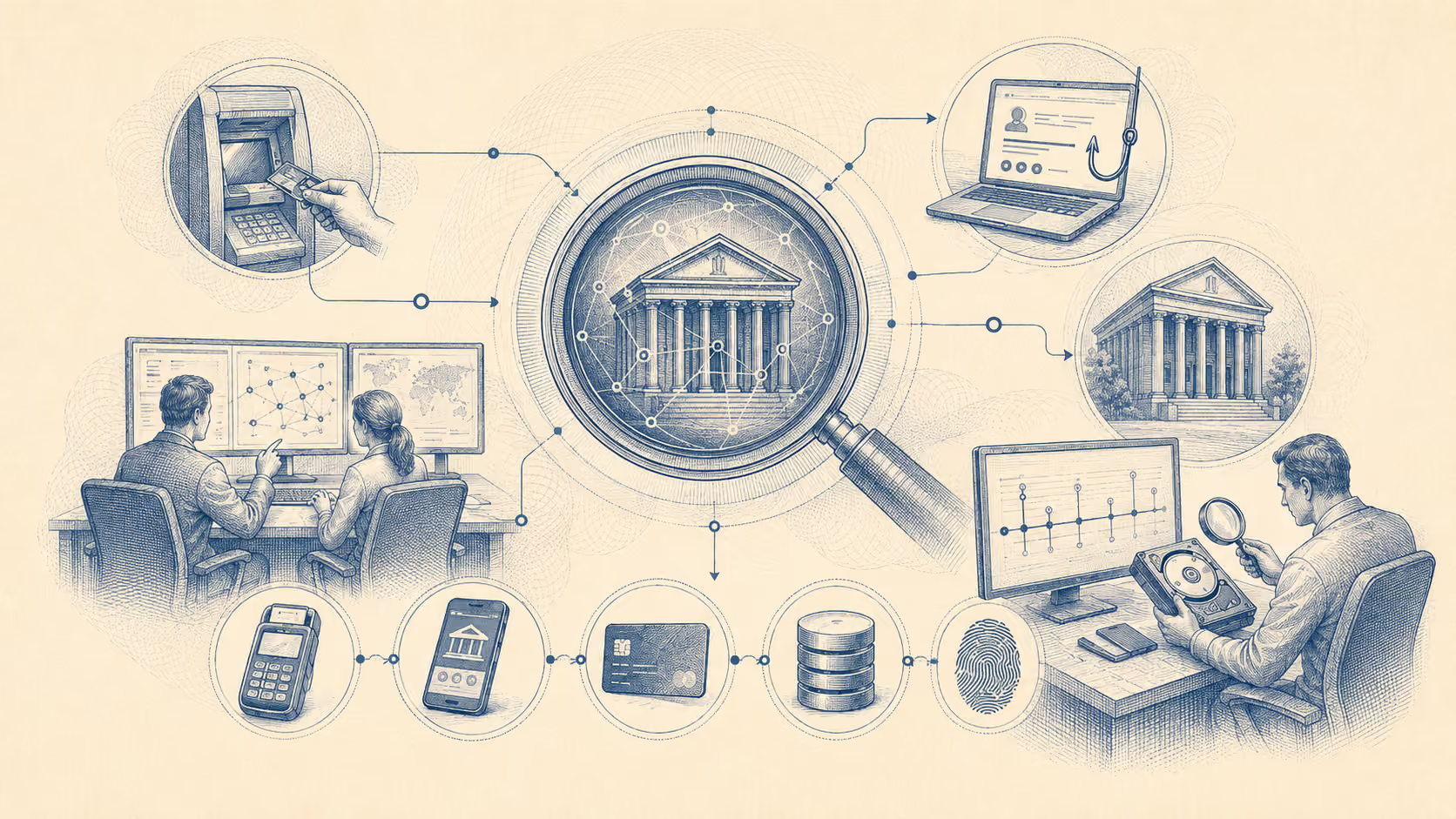
TABLE OF CONTENT
Banking payment environments have undergone a fundamental architectural shift. Transactions are now executed in real time, infrastructure is entirely API-driven, and complex payment workflows span core banking systems, fintech partners, cloud platforms, and national payment rails. While this transformation has unlocked unprecedented efficiency, it has also dramatically expanded the surface area where sophisticated financial breaches can occur.
Attackers today do not always break systems; instead, they embed themselves within legitimate workflows, exploit trusted identities, and trigger transactions that appear operationally valid. As a result, the most damaging incidents in banks bypass traditional security controls. By the time an incident is recognized as an active breach, funds have already moved across multiple accounts, platforms, and jurisdictions.
The Role of Payment Forensics in Banks
A payment forensics investigation in banking refers to the systematic technical analysis of payment-related incidents to understand exactly how transactions were initiated, authorized, processed, and executed, and precisely where security controls failed along that journey. Unlike conventional security monitoring, payment forensics focuses on reconstructing how money moved, how workflows were manipulated, and how controls failed in sequence. It shifts the investigative lens from isolated system alerts to comprehensive transactional narratives.
At its core, payment forensics serves four critical corporate objectives:
- Reconstruct Breach Timelines: Correlating granular technical application logs with financial ledger events.
- Trace Transaction Pathways: Tracking malicious data movement across internal and external systems to identify points of unauthorized manipulation.
- Uncover Structural Weaknesses: Identifying underlying flaws in user identities, business workflows, and technical governance.
- Provide Defensible Evidence: Delivering forensic artifacts that support regulatory reporting, legal proceedings, and institutional insurance claims.
7 Common Payment Breach Scenarios in Banks
Payment breaches in financial institutions rarely follow a single, predictable pattern. They emerge at the intersection of technology, identity, and business workflows. Across global banking environments, certain structural failure chains recur with striking consistency.
1. Real-Time Payment Workflow Hijacking
Real-Time Payment (RTP) environments—such as UPI, IMPS, SWIFT, or international instant settlement networks—were explicitly engineered to eliminate operational friction. Attackers exploit this design principle. Instead of breaking core banking systems, they hijack legitimate workflows. Transactions are executed using valid credentials, approved pathways, and legitimate user interfaces. By the time automated fraud alarms are raised, the money has already moved beyond recovery.
For example, during a targeted security assessment of an internet banking environment, a critical flaw was discovered in a transaction authorization workflow that enabled the exact same One-Time Password (OTP) to be successfully reused to approve multiple distinct fund transfers. This exposed a structural weakness: transaction controls were designed assuming sequential execution, while the threat actors operated in parallel.
2. Compromised Privileged Identities
Banks invest heavily in perimeter infrastructure, yet the most high-impact breaches originate from compromised privileged identities. Attackers obtain access to accounts with elevated permissions through spear-phishing, credential stuffing, or targeted malware. They then reconfigure back-end workflows, modify beneficiary master records, and adjust transaction thresholds—all through seemingly authorized administrative actions, without ever needing to deploy noticeable malicious code.
To stop these identity-centric movements, banks must transition from standard perimeter tracking to continuous, cross-domain monitoring. Utilizing a specialized Managed Extended Detection and Response (MXDR) architecture allows security teams to ingest telemetry from active directory, cloud workloads, and core networks simultaneously to spot anomalous administrative behavior before transactions trigger.
3. Vendor and Third-Party Ecosystem Breaches
The modern bank is a decentralized ecosystem of fintech partners, payment service providers, cloud platforms, and third-party vendors. Attackers understand these interconnected dependencies. They routinely target the weakest link in the supply chain, manipulate external partner systems, and re-enter the bank’s core through trusted API integrations. Common techniques include altering vendor master deposit records, redirecting automated payout accounts, or abusing partner APIs to trigger fraudulent credit balances.
4. Insider-Assisted Payment Fraud
Insider breaches are rarely about rogue employees acting in isolation. They are about how organizational trust is engineered into operational workflows. Approval hierarchies, emergency exception handling, and administrative override mechanisms are designed to keep business moving during disruptions. Attackers exploit these specific design choices, selectively disabling technical safeguards with minimal insider collaboration to slide under fraud detection thresholds.
5. API Abuse in Open Banking layers
APIs were built to enable innovation and open integration. In payment systems, they have quietly become primary channels for financial manipulation. Threat actors do not always exploit APIs as technical code vulnerabilities, but rather as logical execution pathways. By exploiting weak authentication, excessive permissions, or undocumented dependencies between distinct microservices, they chain API calls together to reconstruct unauthorized payment workflows and trigger asset extraction without ever breaching core databases.
6. Shadow IT and Shadow AI in Payment Operations
Banks increasingly rely on unmonitored automation scripts, low-code tools, and generative AI models to accelerate payment operations. When these tools operate outside formal governance frameworks, they create severe blind spots. When breaches occur, investigators face a difficult reality: financial decisions were made by automated systems that cannot be mathematically explained, audited, or traced.
Payment forensics helps expose this category of risk—not malicious code, but ungoverned intelligence. For instance, findings from a web application penetration testing engagement revealed critical flaws in an AI-enabled workflow that accepted a crafted, conflicting prompt as a trusted execution command. This failure in multi-intent parsing and intent handling allowed a chatbot to execute a sensitive action—such as deleting purchase orders—without proper validation or human authorization.
7. Multi-Stage Failure Chains
The most consequential banking breaches are almost never single, isolated events. They are multi-stage failure chains consisting of small, overlooked weaknesses across identity, processes, technology, and governance. Each vulnerability is individually survivable, but collectively catastrophic. Banks do not suffer systemic breaches because a single control fails; they suffer breaches because small failures are distributed silently across the transaction lifecycle.
Building Forensic Readiness in Banking
To successfully mitigate these risks and minimize containment windows, financial institutions must build proactive forensic readiness directly into their operational blueprints:
- Implement Immutable, Centralized Logging: Ensure all core banking systems, API gateways, and payment switches stream logs to a tamper-proof, write-once-read-many (WORM) central repository.
- Deploy Continuous Threat Hunting: Move away from passive alerting by utilizing an AI-native Agentic SOC model to continuously hunt for subtle indicators of compromise (IOCs) across application layers and identity directories.
- Establish a Payment-Specific Incident Response Plan: Ensure your incident manuals contain dedicated playbooks for isolating compromised API keys, freezing real-time payment switches, and immediately mobilizing specialized digital forensics and incident response (DFIR) experts.
How SISA Protects the Banking Ecosystem
Navigating a highly sophisticated payment breach requires a security partner with an elite forensic pedigree. At SISA, we bring over 18 years of global experience resolving high-stakes financial cyber incidents.
Our specialized banking forensics services provide institutions with the deep technical expertise required to contain active transactions, isolate lateral threat movement, and reconstruct legally defensible timelines. Furthermore, for financial institutions handling sensitive cardholder data, pairing advanced threat hunting with a specialized PCI DSS compliance framework ensures your entire transactional infrastructure continuously satisfies the most rigorous international security logging and monitoring standards.
Frequently Asked Questions (FAQs)
What is the core difference between standard security monitoring and payment forensics?Standard security monitoring focuses primarily on infrastructure health and system-level alerts (e.g., detecting malware on a server). Payment forensics focuses entirely on the transaction lifecycle, reconstructing the narrative of how money moved, how identities were leveraged, and exactly how business logic workflows were manipulated by an adversary.
How does the principle of "need-to-know" apply to payment systems?The principle of least-privilege or "need-to-know" ensures that employees and integrated third-party applications are granted the absolute minimum access required to perform their specific functions. In payment environments, enforcing this strictly prevents low-level administrative accounts or vendor APIs from executing high-value wire transfers or altering master configuration records.
Why are traditional SIEM platforms struggling to catch modern payment breaches?Traditional SIEM tools excel at identifying known signature patterns or basic technical anomalies. However, modern threat actors utilize valid credentials and legitimate API pathways to execute fraud. Because these actions appear completely valid on an infrastructure level, they do not trigger standard SIEM alerts, requiring advanced, behavior-based correlation to uncover.
Are digital forensics findings from banking environments admissible in court?Yes. Digital evidence gathered during a bank breach investigation is fully admissible in a court of law, provided that investigators strictly adhere to international evidence collection standards (such as ISO/IEC 27037). This requires proving a pristine chain of custody, capturing unalterable cryptographic file hashes, and ensuring the analysis was performed on forensic images rather than live production data.