Digital Threat Report 2025 - 26
The cyber shifts reshaping BFSI and payments
6/7 predicted threats are now operational
4-layer cyber failure pattern mapped from real incidents
3 shifts now driving attacker speed, scale, accuracy, and autonomy
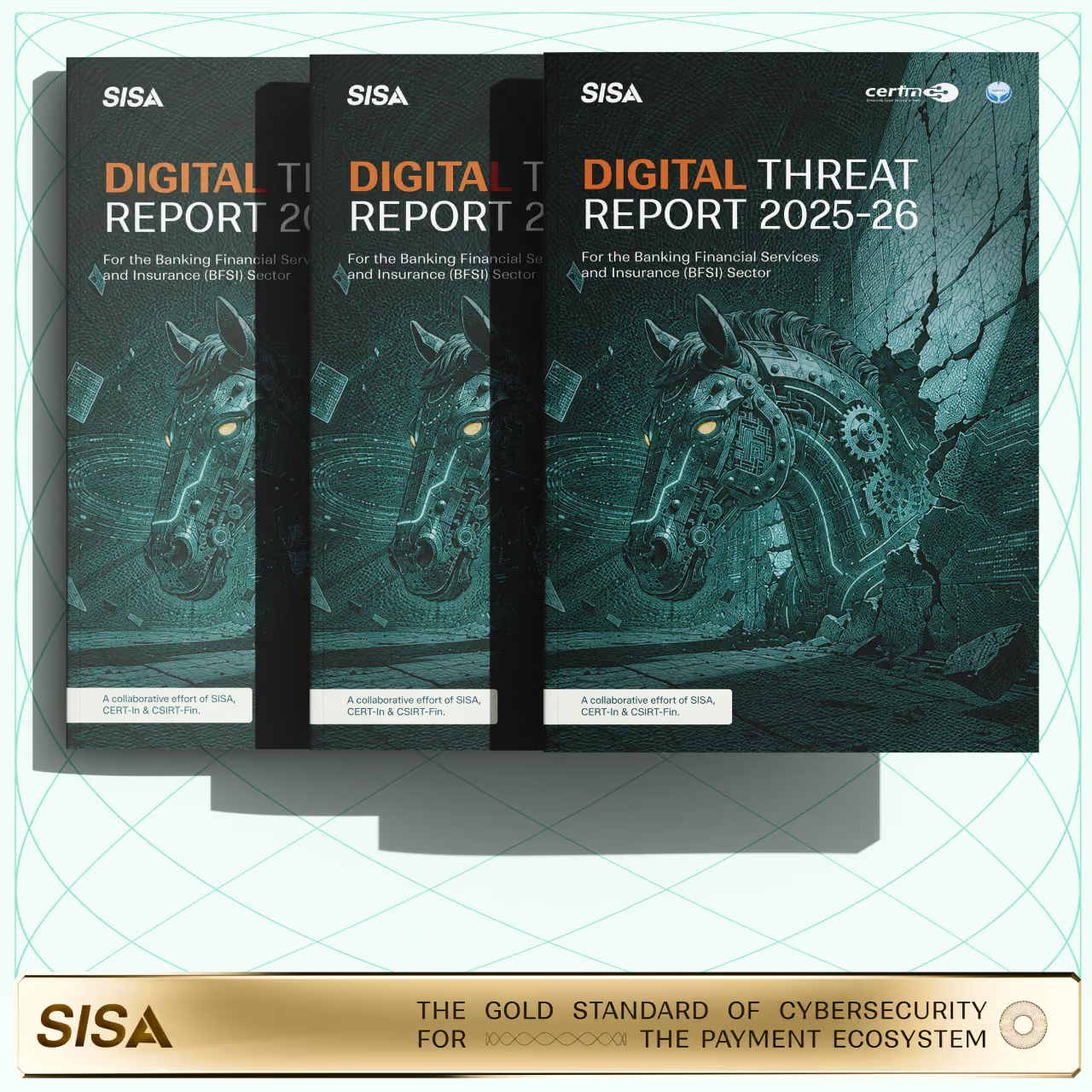

Last year, we made seven predictions - six are already an operational reality:
Supply-chain & malicious libraries
Deepfakes & AI content
Adversarial LLMs
- LLM prompt hacking
- IoT & embedded-device threats
Crypto as an attack frontier
Still emerging: Quantum threat — not immediate, but impossible to ignore.
Three shifts defining the threat landscape
AI & Human Deception
Deepfakes, impersonation, synthetic content, and AI-assisted fraud are turning trust into the attack surface.
Software & Systems
Supply-chain compromise, malicious libraries, APIs, and embedded systems are exposing the technology layers financial institutions rely on.
Infrastructure & Economy
Cloud, crypto, payment rails, and digital financial infrastructure are becoming part of the attacker’s operating model.

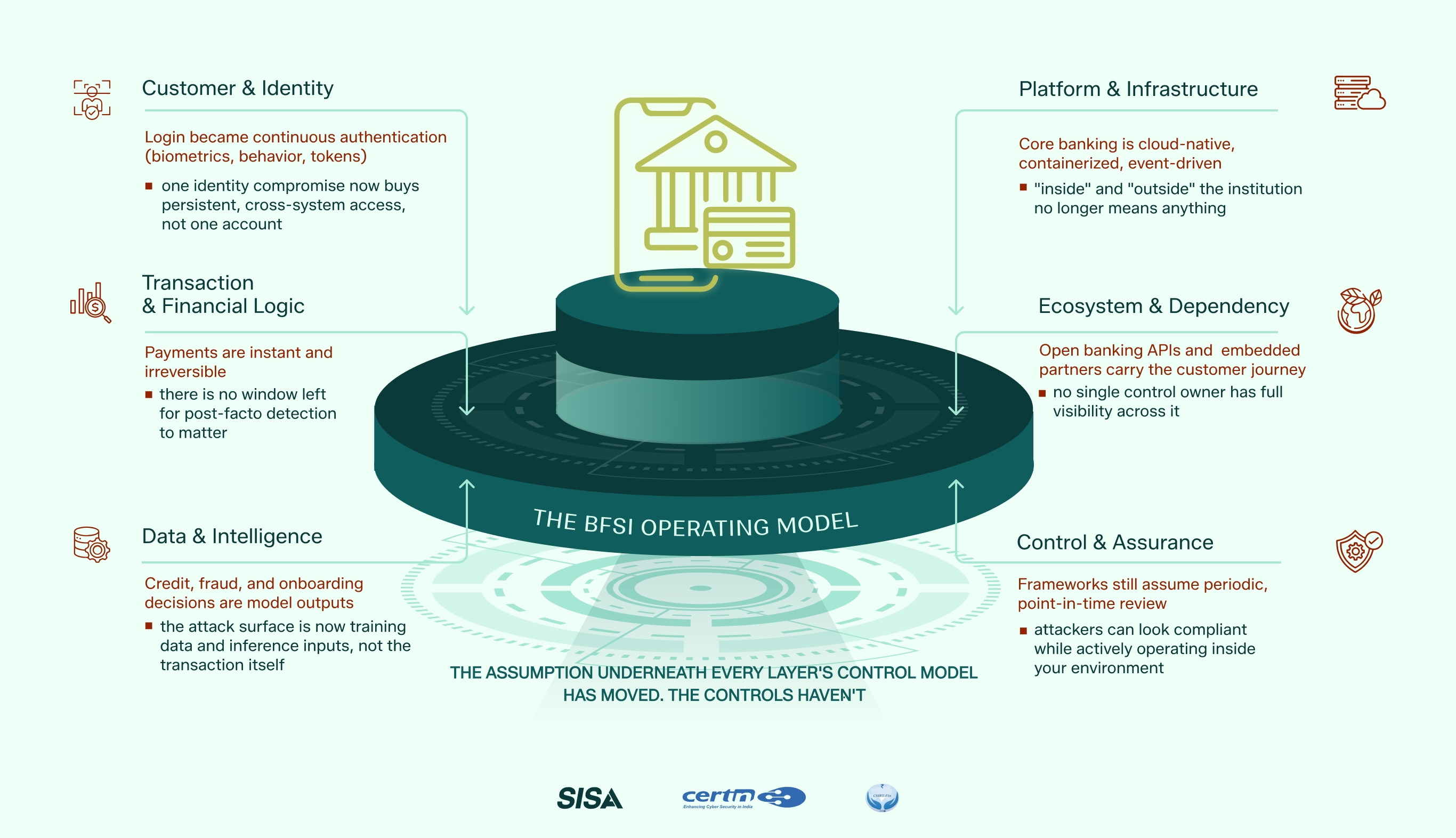
A Full-Stack View of BFSI Cyber Risk
Explore the BFSI Cyber Risk Map
Four interconnected gaps that reveal how modern breaches unfold end to end
The Anatomy of Cyber Failure
01 Design Gaps
Built for correctness — not adversarial reality.
02 Enforcement Gaps
Controls exist, but fail under real-world conditions.
03 Signal Gaps
The right signals aren't generated or interpreted.
04 Response Gaps
Even when signals exist, action fails.


Cyber failure has a pattern
Recurring breach patterns from real investigations mapped to a four-layer gap archetype
Trusted Entry
Attackers enter through users, vendors, credentials, or legitimate channels.
Infrastructure & Identity
They expand through weak identity, cloud, privilege, or configuration controls.
Business Logic
They exploit workflows, APIs, transactions, or process gaps.
Evasion & Visibility
They succeed because signals are missed, fragmented, or unavailable.
What BFSI Must Prepare For Next
AI deception, supply-chain compromise, identity-led attacks, AI system abuse, cloud control-plane risk, business logic exploitation, and measurable cyber resilience.
Stabilize critical exposure in the first 6 months. Operationalize continuous validation in 6–12 months. Adapt for AI-enabled and autonomous attack workflows over 12–18 months.
Move from proving controls exist to proving they work under real attack conditions.
Why Download the Digital Threat Report 2025-26?
Stay ahead of emerging cyber threats impacting the BFSI and payments ecosystem.
Leverage insights derived from forensic investigations, incident response engagements, and broader threat intelligence patterns.
Identify gaps between compliance requirements and real-world security effectiveness.
Access practical recommendations for CISOs, boards, technology leaders, policymakers, and regulators.
Build a structured 18-month roadmap for improving resilience, preserving trust, and ensuring operational continuity.
FAQs
The Digital Threat Report 2025-26 is an executive cybersecurity report for the Banking, Financial Services, and Insurance sector, developed through a collaborative effort by SISA, CERT-In, and CSIRT-Fin. The report examines how cyber threats are evolving across the BFSI and payments ecosystem, with a focus on AI-enabled attacks, identity compromise, supply chain risk, business logic abuse, cloud exposure, and the growing gap between compliance and real-world security resilience.
The report identifies three major shifts defining the BFSI threat landscape: AI and human deception, software and systems compromise, and infrastructure and economic risk. These include deepfake impersonation, AI-driven phishing, session hijacking, supply chain compromise, business logic fraud, ransomware, cloud control-plane attacks, and risks to long-term cryptographic trust.
Compliance remains essential, but the report shows that point-in-time attestation does not prove that controls will survive real-world adversarial pressure. BFSI organizations may pass an audit and still remain exposed due to implementation drift, scope boundary failures, or framework evolution lag. The report recommends moving from periodic compliance validation to continuous assurance, adversarial testing, and control monitoring that reflects how attackers actually operate.
The Anatomy of Cyber Failure is a 4-layer framework introduced in the report to explain how modern breaches in BFSI sector unfold. It shows that cyber failures rarely happen because of one missing control. Instead, they occur when gaps align across design, enforcement, signal, and response. The framework identifies four recurring breach patterns: the Trusted Entry Breach, the Privilege Escalation Breach, the Logic Abuse Fraud, and the Invisible Attack Chain.
The research and insights in the Digital Threat Report 2025–26 are based on a synthesis of SISA’s real-world digital forensics and incident response engagements, observations from CERT-In and CSIRT-Fin on cyber incidents affecting the Indian financial system, cybersecurity reports and threat intelligence data, vulnerability and exploit trends, and research on emerging risks such as adversarial AI, deepfakes, malicious use of large language models, software supply chain compromise, and evolving attack techniques across the BFSI and payments ecosystem.
The Digital Threat Report 2025–26 recommends an 18-month roadmap across three horizons to help institutions move from periodic compliance toward continuous assurance and operational resilience: 0–6 months to strengthen identity, adversarial testing, secrets management, and containment; 6–12 months to build continuous session assurance, transaction monitoring, cloud IAM visibility, and control monitoring; and 12–18 months to advance identity-centric access, AI supply chain integrity, runtime attestation, third-party risk visibility, post-quantum planning, and continuous assurance.