

TABLE OF CONTENT
Modern security operations centers (SOCs) are overwhelmed. Cloud expansion, identity sprawl, AI-assisted attacks, and hybrid infrastructures have created environments where security teams are expected to process millions of events daily while still making rapid, accurate response decisions.
The problem is no longer visibility alone. The problem is operationalizing security signals fast enough to reduce risk. This is where the ProACT Agentic SOC Platform is designed to fundamentally change the workflow. Instead of functioning as a traditional alert-monitoring SOC, ProACT introduces an operational model where AI agents actively participate in detection, investigation, enrichment, prioritization, and response orchestration.
An outcome-driven SOC with unified detection and response workflow
Even with a layered security stack, outcomes do not happen automatically. Effective security operations require intelligence, context, investigation, and response to work together as a unified system.
SISA ProACT Agentic SOC is designed around a unique operational model, that brings together telemetry ingestion, AI-driven investigation, contextual intelligence, orchestration, and response into a unified detection-to-action architecture. With end-to-end detection and response workflows powered by Agentic AI and GenAI, ProACT helps organizations move beyond alert monitoring toward faster investigations, reduced analyst overload, and measurable security outcomes.
How the ProACT Agentic SOC Platform Works/The Detection-to-Response Workflow in ProACT Agentic SOC
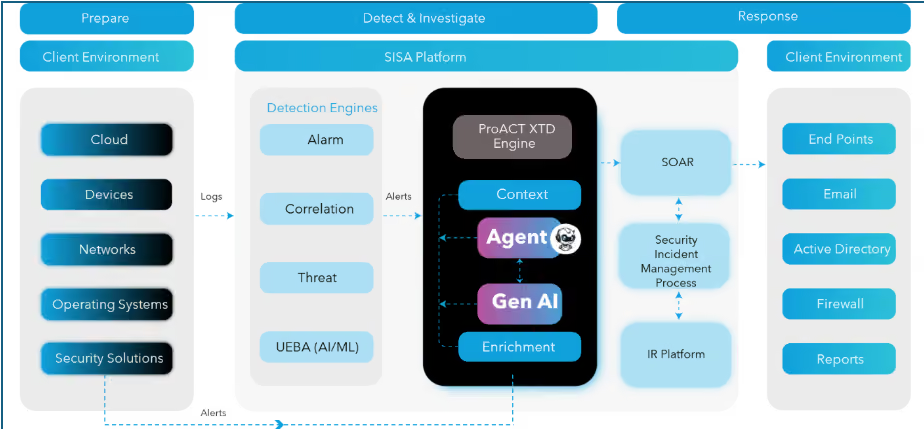
At a high level, SISA ProACT workflow operates across three interconnected stages:
- Prepare
- Detect & Investigate
- Respond
The platform continuously ingests telemetry from the customer environment, applies multiple layers of detection and correlation, enriches incidents using AI-driven context, and orchestrates response actions through integrated workflows.
ProACT Agentic SOC: High-level Logical Architecture
Stage 1: Preparing the Security Environment for Continuous Detection
The ProACT Agentic SOC Platform begins with unified telemetry ingestion across the customer environment. This includes visibility across cloud environments, devices and endpoints, networks, operating systems and existing security controls and tools.
Traditional SOCs often struggle because detections remain siloed across disconnected tools. ProACT addresses this by continuously normalizing and processing telemetry into a unified operational pipeline, enabling downstream engines to analyze activity holistically rather than in isolation.
Stage 2: Detection and Investigation
This is where the Agentic SOC architecture becomes operationally different from a traditional SOC. The first stage of analysis is handled through multi-layered detection engines operating simultaneously, which include:
- Alarm-Based Detection: The ProACT detection engine continuously identifies known attack indicators, policy violations, malware activity, privilege escalation attempts and unauthorized administrative actions. This layer provides deterministic detection for known attack patterns and operational anomalies.
- Correlation Engines: The ProACT correlation engine connects telemetry across systems, users, workloads, and timelines to reconstruct attack progression. For example, cloud privilege escalation after VPN authentication or endpoint execution linked with suspicious outbound traffic. Instead of flooding analysts with disconnected alerts, ProACT consolidates related events into meaningful investigative incidents.
- Threat Intelligence Integration: The ProACT Agentic SOC continuously maps incoming telemetry against 20+ internal and external threat intelligence sources, enabling IOC correlation, threat actor association and campaign-level analysis. This adds adversarial context to operational events, helping security teams understand not just what happened, but who or what may be behind it.
- UEBA and Behavioral Analytics: The ProACT UEBA layer uses AI/ML-driven behavioral analytics to establish operational baselines across users, devices, workloads, service accounts and identities. The platform then identifies deviations such as abnormal access timing, lateral movement indicators or privilege misuse, allowing it to detect threats that may bypass traditional signature-based controls.
The ProACT XTD Engine: The Intelligence Core of the Platform
Once detections are generated, they are passed into the ProACT XTD Engine. This layer functions as the operational intelligence core of the ProACT Agentic SOC Platform and performs three major functions:
Context generation: The engine automatically builds investigative relationships around each event, including asset criticality, user associations, historical activity, identity exposure and business impact which helps it determine the urgency of response, operational severity and potential lateral movement paths.
Agentic AI investigation: The ProACT AI agents actively participate in the investigation workflow and continuously analyze event relationships, query supporting telemetry, build investigative hypotheses, prioritize incidents dynamically, recommend response actions and accelerate triage workflows, offering contextual enrichment rather than isolated prompt-based interactions.
Automated incident enrichment: The ProACT enrichment layer continuously augments incidents with supporting intelligence such as asset metadata, identity risk indicators, historical attack patterns, threat intelligence lookups and MITRE ATT&CK mappings, making them investigation-ready.
Stage 3: Orchestrated Response
Once an incident reaches a validated confidence threshold, the ProACT platform initiates orchestrated response, by integrating three operational layers:
- SOAR-driven automation: The ProACT SOAR layer automates repetitive operational actions including endpoint isolation, IP blocking, account disablement, ticket generation, MFA reset enforcement and escalation workflows.
- Security Incident Management: The incident management workflow within ProACT supports analyst collaboration, evidence tracking, escalation management and regulatory response workflows.
- Incident Response: For high-severity incidents, the ProACT platform supports deeper forensic and response workflows including timeline reconstruction, evidence preservation, root-cause analysis and attack-path reconstruction.
Closing the Loop Back into the Environment
The final stage of the ProACT workflow pushes response actions back into the customer environment. This includes integrated actions across endpoints, email systems, Active Directory, firewalls and reporting systems.
Why the ProACT Agentic SOC Model Matters
SISA’s ProACT Agentic SOC represents a powerful convergence of automation and human expertise, offering a dynamic, scalable, and context-aware SOC framework. By automating 100% of high-volume, repetitive tasks end-to-end, it frees up analysts to focus on complex investigations, strategic decision-making, and contextual activities.
SISA’s deep forensic expertise derived from its unique position of being a leading global Payment Forensic Investigator (PFI) for nearly 20 years is the unique differentiator that fuels the intelligence behind ProACT Agentic SOC platform, making it far more impactful than generic MDR/XDR solutions. With over 1,800 use-cases aligned with MITRE ATT&CK framework and Sigma standards and the ability to integrate with diverse security solutions including SIEM, EDR, CASB etc. ProACT strengthens compliance and security posture, resulting in up to 50% lower mean time to detect (MTTD) and up to 80% reduction in false positives.
To see how ProACT Agentic SOC powers AI-driven detection and response, watch it in action or read our whitepaper ProACT MXDR: an Agentic SOC with a Human Touch. To learn how ProACT can supercharge your SOC operations, schedule a demo.